People Giving a Baby Lion a Bottle Lizard Tongue Clip Art
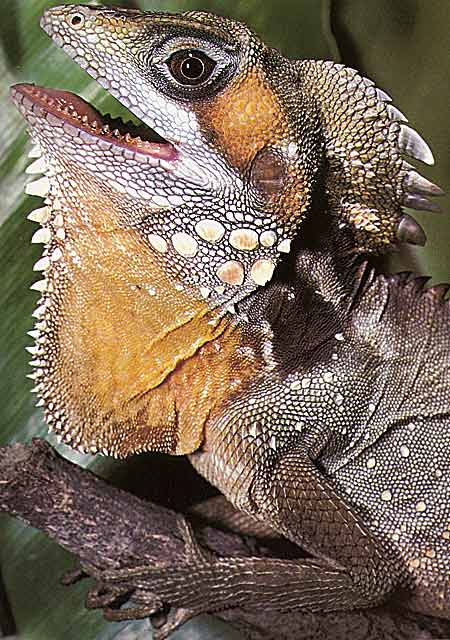
Boyd's Rainforest Dragon
Lizards are reptiles, or members of the course Reptilia, and are descendants of the dinosaurs that in one case ruled the Earth. They inhabit all of the continents apart from Antarctica, from ocean level to heights of 16,500 anxiety (5000m). Lizards live in diverse environments and are the almost geographically widespread of the reptiles. That makes them the largest group of reptiles with nigh 5000 species. They take walked the globe for some 200 one thousand thousand years.
Reptiles take the following concrete features: they have vertebrate, lungs, and scales or plates. They are cold-blooded, getting all of their heating from the environment (the sunday) which can exist mortiferous during cold spells. What could be skilful about that? Well, this allows the reptiles to eat much less than a mammal of the same weight might. In the desert, for example, this might exist useful in terms of competing for food. As well, since they don't demand so much energy from food to heat themselves they can spend more time basking and taking in the sights. However, poor temperature control means they need to be active when the temperature is suitable and for this reason nigh are active during the day.
The classification or taxonomy of lizards can be discipline to interpretation and change but here are the major groups and families:
- Diploglossa: knob-scaled or xenosaurs; glass and American legless lizards
- Gekkota: geckos, bullheaded and legless lizards
- Iguania: iguanas, agamas, anoles, chameleons; casquehead, collared, leopard, earless, spiny, tree, wood, side-blotched, neotropical ground and horned lizards
- Platynota: gila monsters, earless monitors and monitors
- Scincomorpha: skinks, tegus; spinytail, plated, spectacled, wall, and dark lizards
Virtually lizards are four-legged, simply some have only two legs and even a few are leg-less. Their size ranges from 2 in to 10 ft in length. In that location are ii species that are venomous, the gila monster and the Mexican beaded lizard.
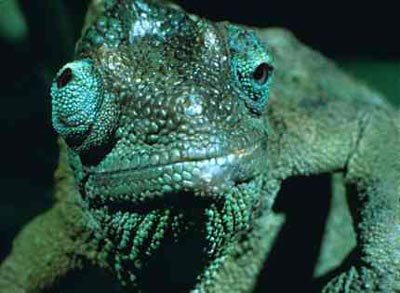
Chameleon
Some lizards change colors very rapidly to match their surroundings, like the chameleon. Their colors are as well affected by the sun. Often, when basking in the lord's day, the colors of a lizard's skin can become bright and vibrant like the collared Lizard. A common cold lizard may be night and colorless.
Distinct colors, bated from simply beingness interesting, like having a blue tongue, a vivid red dewlap, or yellow spots, may help lizards place each other and even communicate. Lizards take very groovy eyesight and they besides use body linguistic communication posturing and gestures such as head-bobbing to communicate with each other.
See more well-nigh Chameleons

Collared Lizard
You may observe that the collared lizard pictured above is shedding a layer of quondam peel. The peel or scales of a cadger is made up of keratin. This substance is also what human fingernails are fabricated of.
Collared lizards are known to be ambitious and they eat other species of lizards.
The Tale of the Amazing Regenerating Tail
Encountering a dangerous predator, some lizards can voluntarily shed their tails into one or more than pieces. Prior to losing the tail, some, such as the Texas banded gecko, slowly moving ridge the vertical tail in the air from one side to some other. This tactic is employed to crusade the snake or other predator to focus on the tail instead of the more vulnerable head or body. The shed tail itself shakes convulsively for several minutes, further distracting the predator and improving the lizard's odds of escaping unharmed with one less body part. Species capable of this feat have a "fragile" tail, with fracture planes in ane or more of the vertebrae. A wall of connective tissue or cartilage passes through each such vertebra, making a weak point, where muscles and blood connections are also modified to permit an like shooting fish in a barrel pause.
Later on shedding a tail the a new one slowly grows back, but never quite the same as the original. It may non have all the vertebrae with fracture planes, but it has all the functions of the original which assist in running, swimming, balancing or climbing, camouflage, courting, mating and fat-storage. If the tail breaks at any other identify than a fracture airplane, regeneration is slight. Losing a tail, though it may save the clever creature'southward life, is not without costs. For example, the fat stored in the tail is normally cleaved down and used for growth and maintenance when nutrient is scarce or no longer bachelor, especially in wintertime or drought. Some species, like the Australian marbled gecko, is known to alive longer when it has a tail. In add-on, the fat stored in a female'due south tail appears to be important in yolk production; individuals defective tails produce eggs with lower mass and less energy, and the offspring survive less well. Tail regeneration itself may require substantial energy, an expenditure that could exist used instead for reproduction, perhaps making larger eggs. In the Texas banded gecko, at least, reproduction is known to have energetic priority over tail regeneration. This may exist true for other brusk-lived species of lizards, specially when the probability of producing offspring is depression. At least some species in near of the families of lizards are capable of tail-loss except for all species of chameleons, beaded lizards, the Bornean earless lizard, monitors and xenosaurs.
Diet
Many lizards are fearsome predators themselves, feeding on insects, birds and even mammals and other members of the reptile family. The most impressive predator would exist the Komodo dragon, that is a scavenger likewise as a predator, and tin overtake goats and even water buffalo. Its teeth are compressed with precipitous edges, resembling those of sharks. The dragon literally rips chunks of mankind from its large casualty. It also possesses a highly flexible skull that allows it to swallow big bites of flesh. The Caiman cadger eats snails. Its rigid skull and tough teeth provide it with the power for breaking shells. A minor percent (virtually 2 percent) of known species of lizards are primarily vegetarian. Iguanas consume a wide variety of plant textile, peculiarly equally adults. The marine iguana of the Galapagos Islands may win the vegetarian prize for their deep diving efforts to observe found material. Some skinks feed on plants and fruits. Other species change their diets as they grow and with the seasons to take advantage of the available food supply.
Territorial skirmishes are mutual among lizards and a number of body movements indicate territorial buying or aggressive intent such as: colour changes, torso inflation, dewlap unfolding, button-ups, jaw-flapping, tail-waving and caput-jerking. Sometimes such behavior can leave posturing lizards vulnerable to vigilant predators. Males are often looking to hold a prissy territory for mating. Females are also territorial in some species.
Body language is also a big part of mating rituals. Head-bobbing, tail-waving, dewlap-moving, dorsum-arching and dancing may exist crucial for mating advice, whether it be accepting or rejecting mates. Other species can employ chemical secretions or vocalizations to communicate mating information. There are species of lizards that accept no males! The females produce eggs that need no fertilization. This, however, limits the genetic diverseness of the species.
Most lizard parents don't care much for their offspring. At that place are a few species that may watch over their eggs. Otherwise, mating and finding a skillful spot to lay eggs is considered a job well-washed.

Common Iguana
Unfortunately for lizards, life on the earth populated with humans is not all about good times. Central Americans similar to eat the iguanas and call back they taste proficient, calling them "tree chicken". In Central America, the blackness iguanas are called garrobos, and the green iguanas are called iguanas, so you might discover "sopa de garrobo" or "iguana soup" on some menus. Charbroiled tail of iguana tin can likewise be found. The common method of hunting is with a slingshot. Freshly killed prey is often held upwards for display alongside the highway by the hunters, in club to entice buyers. Another cadger, the uromastyx or spiny-tailed cadger, is commonly eaten in many countries from Northern Africa through the Middle East and in Republic of india.
Common Iguanas are bang-up swimmers. When attacked, an iguana may jump from a tree or rock into the water to swim abroad.
Marine iguanas live just on the Galapagos Islands and it is idea that they arrived to the islands by floating from mainland Southward America on debris. They can dive as deep equally 50 anxiety (15m) underwater to feed on algae. They can stay under water for upward to 20 minutes. In social club to stay downwardly for very long in colder temperature h2o they have to kickoff estrus upwardly their bodies in the sun, slow downward their hearts in the water, then re-estrus in the sunday again once they go out.

Basilisk - Source: Tad Arensmeier
Basilisks are nifty runners. When in danger, these lizards first running upright on their back legs. They can fifty-fifty run fast enough to walk, or run really, on water. This has acquired them to be referred to equally the "Jesus Christ Cadger".
Come across more about the Jesus Lizard
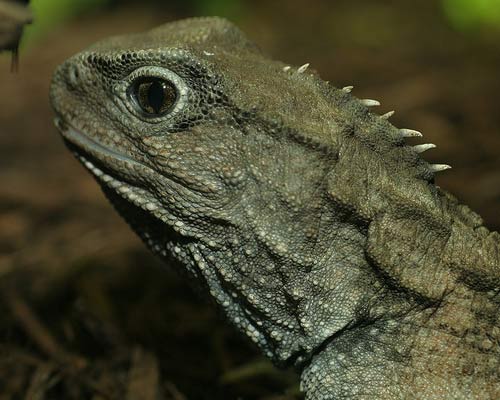
Tuatara - Source: Tad Arensmeier
The tuatara has virtually remained the same for over 140 million years. The tuatara is a reptile, but not in the cadger family unit, it is part of the family Rhynchocephalia (which translates to Beakheads) which appeared over 220 million years agone. All the Beakheads, besides the tuatara - 2 species, became extinct about 60 million years ago. They are very rare, nocturnal animals.
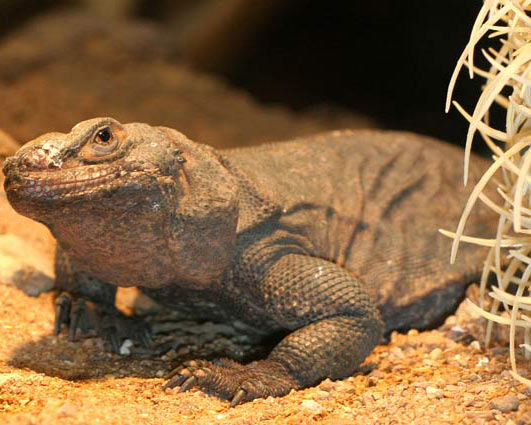
Chuckwalla - Source: Tad Arensmeier
Chuckwallas are rock dwellers in the Southwest USA and Mexico. When threatened, they crawl into crevices and puff-up their bodies so that they are tightly wedged in and nothing tin can yank them out.
Lizards have crude tertiary eyes on top of their heads that senses whether it'south mean solar day or night.

The "horned devil cadger" shoots blood from its eyes to scare away predators.
Also run across the similar thorny devil

Flying Dragon Cadger
A flight dragon lizard avoids danger by opening two large, winglike flaps of pare and gliding from tree to tree. The lizard steers and brakes with its tail. The large flaps are supported by elongated ribs which they can expand and retract. The wings are brightly colored and for this reason they are also chosen the "butterfly lizard".

Bearded Dragon Lizard
The Disguised Dragon is one of the nigh common cadger pets, along with iguanas. They are generally docile.
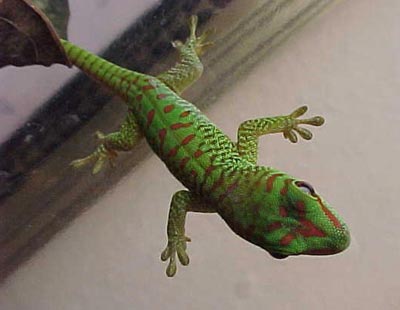
Gecko
The Gecko is the only lizard and reptile that speaks or barks. Many species are well known for their specialized toe pads that enable them to climb smooth and vertical surfaces, and even cantankerous indoor ceilings with ease. At that place are an estimated 2,000 different species of geckos worldwide, with many in existence nonetheless nevertheless to exist institute. Just recently a 100-million-year old gecko species was discovered in the Eastern Himalayas.
One gecko with distinct coloring and bawl! - Tokay Gecko

Frilled Lizard
This defensive posture of the frilled lizard is intended to increase its credible size and intimidate adversaries. They open their frills around their necks and hiss when threatened.

One-time-Human being Lizard aka Casque-Head Lizard aka Hernandez's Helmeted Basilisk (Corytophanes Hernadezi) - Belize - Source: Kristiina Hurme
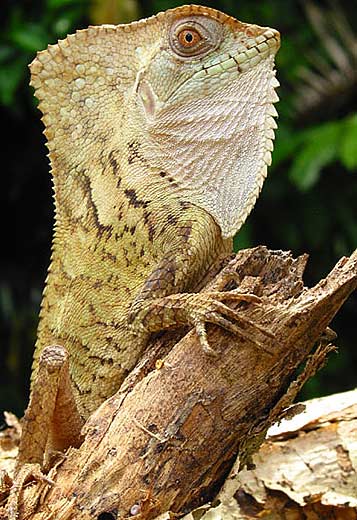
Old-Man Lizard aka Casque-Caput Lizard aka Hernandez's Helmeted Basilisk (Corytophanes Hernadezi) - Belize - Source: Kristiina Hurme
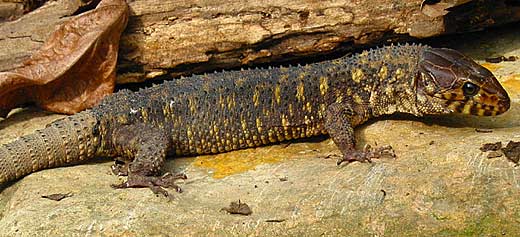
Yellow-spotted Night Cadger (Lepidopyma Flavimaculatum) - Belize - Source: Kristiina Hurme

Blue Tongued Skink

Asian Agamid
Agamids are lizards of the Sometime Earth. There are more than 300 dissimilar species in Africa, Asia and Commonwealth of australia. Their counterpart in the Americas would be the Iguanidae. Some agamids enjoy the water and others adopt the copse.
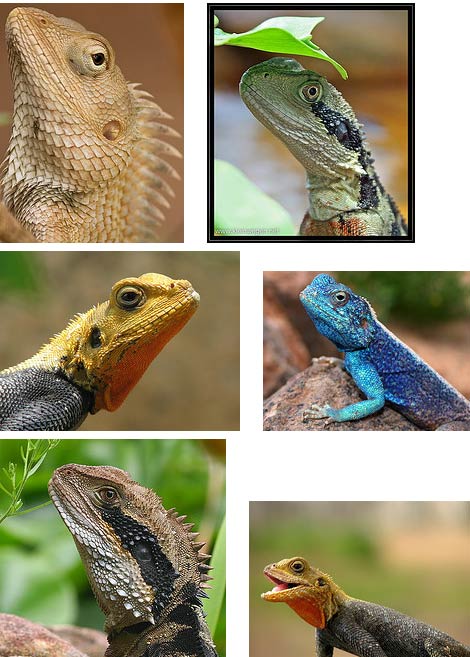
Source: https://www.factzoo.com/reptiles/types-of-lizards.html
0 Response to "People Giving a Baby Lion a Bottle Lizard Tongue Clip Art"
Post a Comment